
Tapping into Tapir Wisdom
On doing ecosystem work even when you can't see it growing

Let’s talk about Tapirs.
These large creatures (often getting up to 600 lbs!) look like a cross between a rhino and a baby elephant. Their appearance is marked most notably by their prehensile trunk that forms a kind of elongated nose.
Unlike other large nocturnal mammals, the tapir doesn’t specialize. It moves between jungle, grassland, and water with ease - that range makes it resilient and necessary to its ecosystem.
On a recent night hike in Belize, our guide shared that we wouldn’t likely see many large mammals. Instead, we spent our time wandering through the Jaguar Preserve catching the light’s reflection off of eyes (so many eyes!) on either side of the path and listening to a kinkajou scurry overhead, while avoiding the shells and partially eaten fruit it was dropping upon us. By the end, we had a collection of mosquito bites, alongside pictures of a few snakes, including a deadly pit viper, and many tarantulas and wolf spiders. A classic night hike. We loaded up in our car, ready to wrap up the night.
Just as we were exiting the park, our guide slammed the brakes. Ahead of us, slowly moving across the path, was a large creature with a strange nose that looked like something out of a child’s drawing book. The shy, nocturnal tapir.
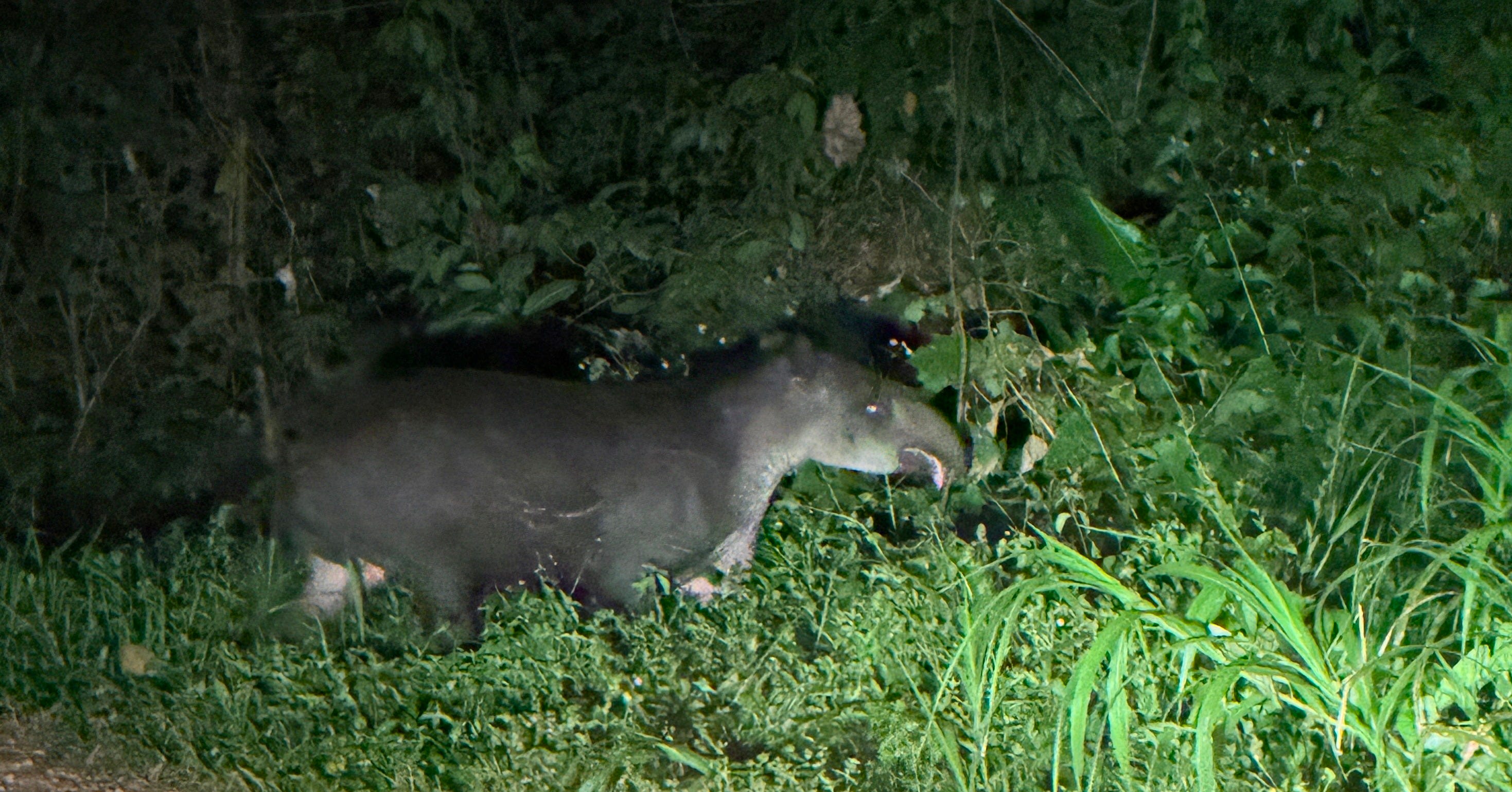
I hadn’t even thought about the possibility of seeing a tapir at night. An ocelot? Maybe. A jaguar? The dream. But an ungulate? In my head, perhaps colored by my primary wildlife experiences in the US, Kenya, and India, ungulates are day creatures. Not elusive night wanderers.
Unbothered by our presence, this giant, gentle nightwalker ambled across the road and continued its grazing on the other side. Our guide shared that this was only the second time he had seen a tapir in the wild, as he filled us in on what he knew.
As one of the only creatures that consume larger fruits and disperse seeds across the forest, tapirs play a significant role in shaping the environment in which they live. The jungle benefits from what they leave behind. It has predators, but its range means it always has somewhere to go.
The tapir isn’t navigating the night the same way as everything else. The jaguar’s stealth, the viper’s quick strike, the wolf spider’s glowing eyes, the kinkajou’s chaotic treetop scramble - all of that felt like a kind of fierceness suited to what I expect in the darkness. The tapir has none of that.
As I look at what leaders and communities are facing right now, this encounter with a tapir feels especially timely. The more we find ourselves in times of uncertainty, the more pressure there is to adapt by becoming sharper, to strike at whatever is passing by. The system tells us that to keep up with the chaos, we have to also let the chaos become part of us.
The tapir reminds us that there is more than one way to navigate the dark.
The tapir doesn’t move through the night with urgency. It doesn’t try to become the jaguar. The tapir is a study in navigating uncertainty not through stealth, but by being present for what’s necessary right now. After all, the tapir spends its nights just doing the things only it can do - eating the big fruit, spreading seeds - even when it can’t see them take root.
The tapir is doing ecosystem work.
The times we are in today require leaders who can hold that same ecosystem perspective. For many of us, the impact of our efforts is not something we will see in the next six months, two years, or even ten years. For leaders building something new, much of the work happens in the dark, without confirmation or validation that we’ve planted the seeds. It’s easy to feel exhausted when you have to keep trudging through the jungle without knowing what comes next.
It’s in these moments that the tapir offers us wisdom to consider. Keep dispersing seeds. The forest you’re creating may not be visible to you, but over time, you’ll start to see what’s growing.
A Tapir’s Ecosystem Leader Practice
Eat and poop. Yep. The tapir’s contribution to the ecosystem comes down to the simplicity of biological functions. Take in what’s in front of you, do your thing, and trust that you’re leaving something behind worth growing.
We can’t all be kinkajous jumping across the treetops right now, even if we want to be. So, when the opportunity allows, move a little slower and cultivate the discernment that you need to navigate the night. Plant a seed you may not see grow.
If you’re feeling pressure to become something you’re not to keep up with what’s happening all around us, consider staying a creature of both land and water. Keep your range. The weird-looking giant who just does its quiet work in the forest is necessary, too.
What’s one way in which you’re planting seeds in the ecosystem? Let’s hear about it in the comments.
Your (covered in mosquito bites) night walking field guide,
-S
If the tapir’s wisdom resonated, these might too.


I needed this reminder. Thank you!! ❤️
Let’s hear it for the weird looking forest giant! Love the reminder to do your own thing and trust the process.